SOLVING STRATEGY
Solving guide
How to choose a stronger second Wordle guess
Use the first row's color feedback to decide what to test next, keep confirmed letters in place, and avoid repeating information you already know.
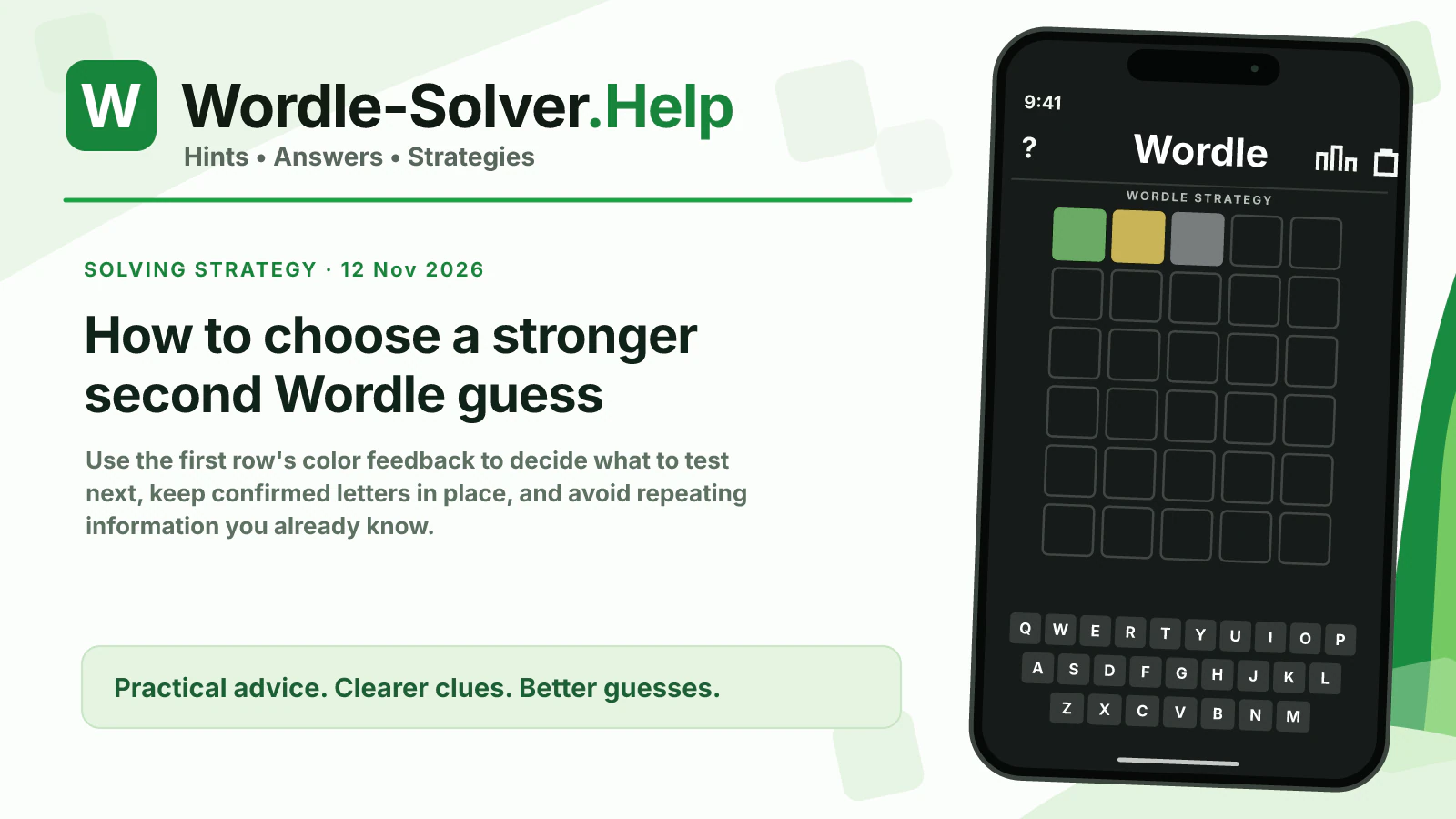
Your second guess should respond to the board, not follow a fixed list of favorite words. After the first row, separate what is confirmed from what is still unknown. Green letters are fixed, yellow letters must move, and gray feedback removes letters or limits duplicate counts.
Start with the information you already have
Write down every green position and every yellow letter. A yellow letter cannot stay in the same position where it appeared. Also note gray letters, but check whether the same letter received a green or yellow tile elsewhere in the row. That combination can mean the answer contains a limited number of copies.
Choose a guess that tests unresolved letters
When several candidates remain, compare the letters they share. A useful second guess often tests common letters that have not appeared in the first row. It does not always need to be a possible answer: a word that separates several candidates can be informative, provided it is accepted by the game.
Avoid repeating low-value information
Do not spend another row on letters that the first guess has already ruled out. Keep green letters in their exact positions and place known yellow letters elsewhere. If a duplicate letter is possible, use the solver's count rules rather than assuming every gray tile means the letter is completely absent.
Use the candidate list as a decision aid
Enter the first guess and its exact tile colors into the solver, then add the second row after you play it. The results are matches against the site's reference dictionary, not a promise that each candidate is an accepted answer in every version of Wordle. Use the list to compare possibilities, then confirm the next guess against your own board.
COMMON QUESTIONS
Wordle strategy FAQs
What is the main takeaway from this Wordle guide?
Use the first row's color feedback to decide what to test next, keep confirmed letters in place, and avoid repeating information you already know.
Can I apply this technique to my own puzzle?
Yes. Enter the guesses you have already played and match each tile to its green, yellow or gray result in the Wordle Solver. The tool combines your feedback and shows five-letter candidates that satisfy the constraints.
How does the solver handle duplicate letters?
It evaluates exact green matches first, then counts remaining copies before assigning yellow matches. A gray duplicate can set an upper limit on how many times a letter may appear.
Where can I find today's hints and answer?
The daily Wordle newsroom publishes date-matched hints and a spoiler-controlled answer separately from evergreen strategy guides.